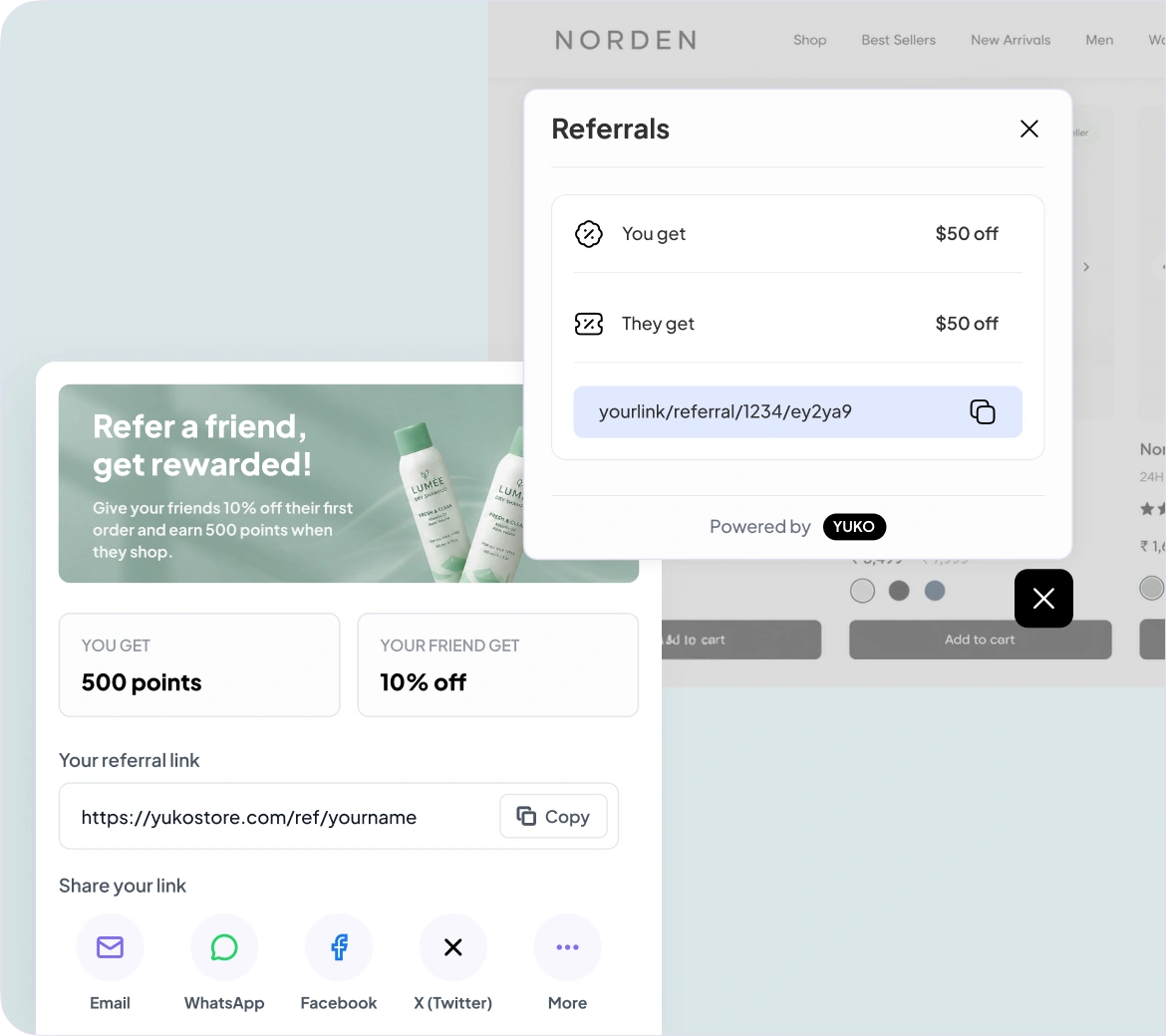
Ads cost more every year. A referral costs you one reward, and only after the sale. Every customer gets a link to share with their friends.
Yuko creates it for them after they buy.
You set the referrer and friend rewards separately.
Yuko blocks self-referrals, throwaway emails and repeat devices.
Referral sales show up in your analytics like any other channel.
Referring customers for
200+ Shopify stores worldwide
A referral program pays your existing customers for bringing you new ones. Each customer gets a personal link. When a friend buys through it, both sides get a reward.
The maths is simple. You pay nothing to reach the friend. You pay the reward only when they buy. An ad charges you for every click, whether it sells or not.
Referred customers are also better customers. A friend arrives already recommended, so they trust you sooner and stay longer.
You pay the reward only after the friend buys. You spend nothing up front.
A friend hears about you from someone they know. That beats an ad in a feed.
You set the two rewards once. After that the program keeps going by itself.
You set both rewards once. Yuko creates the links, tracks the orders and pays out.
Every customer gets a unique referral link after they buy. Yuko creates it for them.
They send the link to friends on WhatsApp, email, Facebook or X. It takes one tap.
The friend opens the link and lands on your store. Yuko applies their reward at checkout.
Yuko pays your customer once the order qualifies. The reward lands in their account.
Set each side of the reward on its own. What the customer earns and what the friend gets do not have to match.
Referrers and friends want different rewards. Your customer wants a reward worth sharing for. Their friend wants a reason to try you. You set the two rewards separately, so both make sense.
Customers share in one tap: Pick the channels that suit your customers. The widget shows only those, and every share carries that customer's own link.
Customers need to find their link easily. It sits in the Shopify customer account, on your rewards page and in the floating launcher. Add a dedicated page too, if you run campaigns.
Yuko checks every referral before you pay. It blocks self-referrals by matching email, IP and device. It rejects throwaway email addresses, and limits how many referrals come from one IP.
Referral sales show up in your analytics: Yuko adds UTM tags to every referral link. You see the traffic and the orders next to your other channels.
Yuko emails customers at each step. It sends the emails itself, or fires the events so Klaviyo can. Either way your customer hears when their friend buys.
Six ways to thank the customer who shared. Most merchants pay in points, because points feed straight back into the loyalty program you already run.
The friend gets a discount at their first checkout. You can ask them to spend a minimum amount before it counts.
Customers share more when the link is easy to find. Yuko puts it in four places.
The referral widget sits inside the loyalty hub, in the account customers already log in to. No second login and nothing new to explain.
The hosted rewards page carries the referral link alongside points and rewards.
A button on every page opens a panel with the link, ready to copy.
Embed the widget on a page such as /pages/refer-a-friend, then point email and ads straight at it.
Yuko checks every referral before you pay a reward. You also get controls to tighten the rules further.
[Two or three sentences of context. What they ran before, what they changed, and what happened after. Replace with a cleared merchant story.]
Read the story →These are published research figures about referrals in general, not Yuko results. We are new on Shopify, so we would rather show you the evidence for the channel than numbers we cannot yet stand behind.
[Placeholder subhead. One line describing the kind of merchant who runs referrals with Yuko.]
“[Longer placeholder quote. Two or three sentences on what the referral programme changed for this merchant. Replace with a verified quote.]”
“[Placeholder quote about referrals. Replace with a verified merchant quote.]”
“[Longer placeholder quote. Two or three sentences on what the referral programme changed for this merchant. Replace with a verified quote.]”
“[One short, strong sentence from a merchant about referrals.]”
We move your data for free. It is part of support.
A few clicks. No developer needed.
Points, members and tiers. Our team migrates everything and checks it before launch.
Your customers keep every point they earned, and the program gets better.
Referral points land in the same balance customers already collect. One programme, one rewards page, one record.
The customers who refer most are usually the ones who spend most. Give that group a bigger referral reward than everyone else.
It is a program where your existing customers bring you new ones. Each customer gets a personal link. When a friend buys through that link, both people get a reward. You pay only after the sale.
Every customer gets their own link automatically. They share it on WhatsApp, email, Facebook or X. The friend lands on a page you choose and gets a reward at their first checkout. Yuko then pays your customer once the order qualifies.
Points, store credit, an amount discount, a percentage off, free shipping or a free product. Most merchants pick points, because they feed the loyalty program you already run.
The friend gets a discount: an amount off, a percentage off, free shipping or a free product. It applies at their first checkout.
Yuko blocks self-referrals by matching email, IP and device. It rejects throwaway email addresses using your blacklist. It also limits how many referrals come from one IP or device. You can ask for a minimum spend, and cap how many friends one customer earns rewards for.
In the Shopify customer account, on your rewards page and in the floating launcher. You can add a dedicated page too. The widget shows their link, one-click share buttons and how many referrals they have made.
No. Every customer gets a link automatically. You can switch to manual sign-up if you have a legal or brand reason to make people opt in.
Yes. Yuko writes UTM parameters onto referral links, so referral traffic and orders appear in your analytics alongside your other channels.
Yes. Referrals and loyalty run in the same app and share one customer record. Points from a referral land in the balance customers already have.
Yes. Yuko sends the referral emails itself. It also fires referral events into Klaviyo, so you can build the flows there instead.
Yuko Advanced is $30 a month and includes 300 orders, then $5 for each additional 100 orders. Growth is $199 a month with unlimited orders. Referrals, loyalty, VIP tiers and memberships are all in the same app.
Personal links and rewards on both sides. You manage no coupon codes.